Jodiji, temple 49, Shikoku
Another unremarkable temple

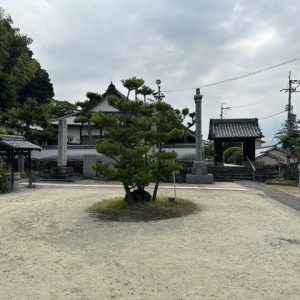


We were asked to pay 100 yen for parking. A reminder that Buddhist temples in Japan are private enterprises.
At the entrance of the temple grounds stands a monument inscribed with Masaoka Shiki’s haiku, “November lays, Kuya lives in his bones.” Jōdoji houses an image of Kuya Shonin (903-972). Kuya Shonin was a tenth-century wandering monk, a hijiri. He is shown as a thin man with a bent waist, clad in deerskin and walking across the temple grounds while clapping a gong and holding a walking stick.
The image evokes stories of him chanting Namu Amida Butsu (“I venerate Amida Buddha”), with each word coming out of his mouth as a small Buddha. He traveled around Japan repairing roads, building bridges, and digging wells for the benefit of the people. He also cremated corpses abandoned in the wilderness and prayed over them, chanting his devotion to Amitabha Buddha.
Jōdoji enshrines a statue of Kuya Shonin in a shrine in the Hondo. According to legend, the temple was founded in the Tempyo-shoho era (749-757) by Shonin Emyo as an imperial temple of Emperor Kohken (749-758), a female emperor.
The principal image is a statue of Shaka Nyorai (the Historical Buddha) carved by Gyoki (668-749). At that time, it was a temple of the Hosso sect of Buddhism. Later Kobo Daishi visited the temple, rebuilt the buildings, and converted it to the Shingon sect. Since then the temple has flourished, covering a large area and having 66 branch temples.
Kuya Shonin made a pilgrimage to Shikoku and stayed at Jōdoji during the mid-Heian period (794-1185). During the Tentoku period (957-961), he taught the villagers and won their respect. In 1192 Minamoto no Yoritomo restored the pagoda to pray for the prosperity of his family. However, it was destroyed by fire in 1416. It was rebuilt during the Bunmei era (1469-1487) by the feudal lord Kono Michinobu. The Hondo and a miniature shrine in the inner temple were built then. They were repaired in 1961. This simple yet solemn building is a blend of Japanese and Chinese styles, and is a National Important Cultural Property.