Yokomineji Temple 60 on the Shikoku pilgrimage
Third highest point on the Shikoku pilgrimage

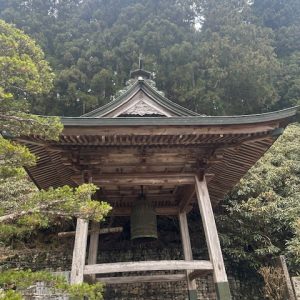
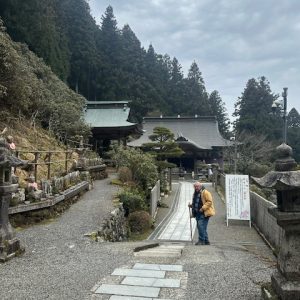
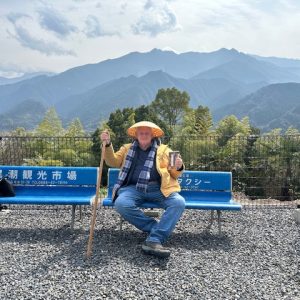
Accessing this temple was an arduous journey. First, we drove up rather high, navigating a very tortuous steep road. Then we had to take a bus up to the top. The driver had been doing this trek for years, but I was still a little nervous. But it was worth it!
Ishizuchi, the highest mountain in western Japan (1982 meters elevation), is a sacred site of mountain worship and a center of Shugendo (mountain asceticism). Kobo Daishi says he engaged in Buddhist training here in his book Sankyo Shiiki, written when he was 24 years old. “At one time, I went to Ishizuchi and practiced asceticism on this mountain.”
The temple grounds are located on the northern part of the mountain at 750 meters. It is the third highest point in the Shikoku Pilgrimage and the most difficult place for henro korogashi, which literally means pilgrims tumbling down. This refers to steep sections where it is easy to slip and fall. A paved road up the mountain was completed in 1954, so now visitors can drive to a parking lot which is 500 meters from the temple. However, the road is closed from late December to the end of February. Large buses are not allowed on this road.
According to legend, in 651, while En no Gyoja was doing ascetic training in the Hoshigamori forest on Ishizuchi Mountain, the god Zao Gongen appeared near the summit of the mountain. En carved an image of the god into a rhododendron tree, built a small hall, and enshrined the image within the building.
That is said to be the origin of the temple. During the Enryaku era (782-806), a hermit called Kokusen Sennin lived at the temple and is said to have healed Emperor Kanmu (781-806) of a brain disease, and thus received the title of Bosatsu (bodhisattva). Kobo Daishi conducted a Hoshi Matsuri (Purifying fire ritual) at this temple during the Daido period (806-810) to pray for good luck and to ward off bad luck. At that time, he also sensed the presence of Zao Gongen, so he built a hall and made it a sacred site. In 1909 the temple was restored with the help of a group of believers.