Kōonji Temple 61 on Shikoku pilgrimage
Koonji is one of the oldest temples on the Shikoku pilgrimage


This temple has a long history, but its current modern building has no particular charm.
Kōonji is one of the oldest temples of the Shikoku Pilgrimage. It was founded by Shotoku Taishi (574-622). In contrast to this ancient origin, it has a modern style main building that serves as both the Hondo and the Daishido. The Koyasuko Circle, a voluntary organization of followers associated with the temple, has spread overseas and now has more than 20,000 members.
According to legend, the temple was built by Prince Shotoku Taishi to pray for the recovery from illness of Emperor Yomei (reigned 585-587). It is also said that at this time a white-haired old man in a gold robe flew in front of the prince, who then enshrined a statue of Dainichi Nyorai (Mahāvairocana) as the principle image of the temple. The emperor bestowed upon the temple the imperial title of Kyōōin. Gyoki (668-749) visited the temple during the Tempyo period (729-749).
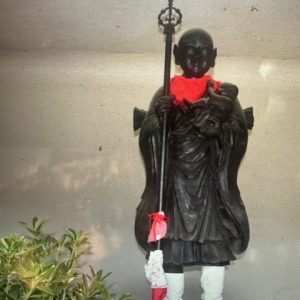
Kobo Daishi visited the temple during the Daido period (806-810). One day there was a pregnant woman in pain in front of the temple gate. Kobo Daishi burned incense and prayed for the woman, and she gave birth to a healthy baby boy. Kobo Daishi then took a small gold statue of Dainichi Nyorai that he had brought back from Tang China and enshrined it as the principal image of the temple. He burned incense again and performed a goma ritual (a fire offering ceremony) to pray for safe delivery, child rearing, and for the woman to become a Buddha. The temple was then designated as a pilgrimage temple. The mountain name of Kōonji (temples are metaphorically called mountains), Sendansan (Sandalwood Mountain), comes from this story.
The temple flourished as a place of worship for safe childbirth and child rearing. Seven major temple buildings and six monk’s cells were built, but they were destroyed by fire during the Tensho era (1868-1912). In 1914 the head priest, Yamaoka Zuien, rebuilt the Hondo. In 1918 he founded the Koyasu-ko, a children’s prayer group. He traveled not only throughout Japan but also to Southeast Asia and the U.S. to expand the number of members and to promote the temple’s prosperity.