Mandaraji Temple 72, Shikoku
Mandaraji is the oldest temple on the Shikoku pilgrimage
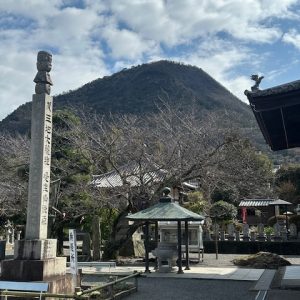
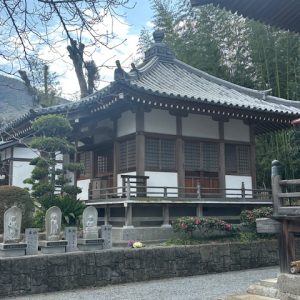
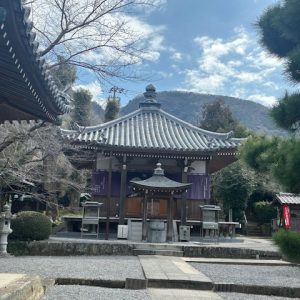


Mandaraji was founded in 596, making it the oldest temples on the Shikoku Pilgrimage. It was built as a family temple of the Saeki family, the family of the lords of Sanuki (Kagawa), and was initially called Yosakadera. Kobo Daishi visited this temple in 807, the year after his return from China. He came to pray for the repose of the soul of his mother, Tamayori Gozen.
It took him three years to build a temple complex modeled after Seiryuji Temple in China. He dedicated a statue of Dainichi Nyorai (Mahāvairocana) as the principal image, set up mandalas of the Diamond Realm and the Womb Realm that he had brought back from China, and renamed the temple Mandalaji.
Old guidebooks of the Shikoku Pilgrimage also mention the existence of a Furo Matsu, an old pine tree that was planted by Kobo Daishi at this time. It was less than 4 meters tall but 17 or 18 meters in diameter, making it very impressive. It looked like two sugagasa, the conical straw hats worn by pilgrims. It was designated a Prefectual Natural Monument, but it was damaged by pine beetles and was cut down in 2002.
Near Mandaraji is a hill called Mizuguki no Oka (Hill of Writing Brush). The poet Saigyo Hoshi built a hermitage here and lived in the hut for more than seven years. He often went to this temple and took a nap on a flat stone in front of the Hondo. The stone is still there. It is known as Saigyo’s Napping Stone.
There is a cherry tree next to the stone called Kasa Gake Zakura (Left Behind Hat Cherry Tree). It is said that when Saigyo was returning to the capital, he saw his companion had left a hat on the tree as a memento and composed a poem, “The hat is there. What will happen to the owner? Sad rain is soaking the ground.”
Mandaraji is the oldest temple on the Shikoku Pilgrimage.