Kirihataji, Temple 10, Shikoku
One of the very most beautiful temples

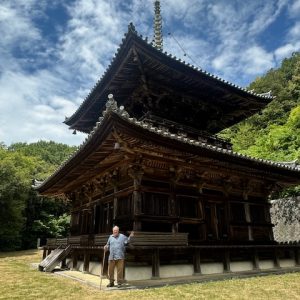
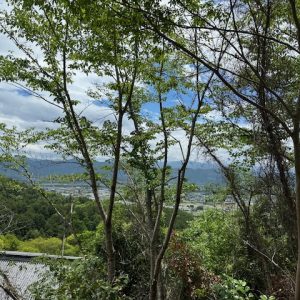


One of the very most beautiful temples. It begins with a walk up about 400 stone steps through a very beautiful dense forest. From the very top there is a beautiful view across the valley.
I met a number of other pilgrims. One man lost his wife in March so he was walking to pray for her soul. Another brave pilgrim was a man of 81 years.
One pilgrim, one month older than me, is a widow with no children. His hobbies are pilgrim walking and playing piano, he loves Debussy.
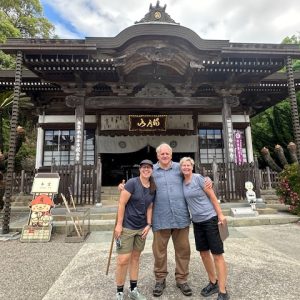
And lastly, I met two Australian girls from Brisbane
Kirihataji is located partway up Mt. Kirihata, at an elevation of 155 meters. The view from the large pagoda, a National Important Cultural Property, is magnificent. The Yoshino River flows calmly below and the majestic mountains of the Shikoku Range stretch out in the distance.
Below the temple is a town that was formed due to the presence of the temple, where there were several inns and stores that sold pilgrimage supplies. The temple is known as the place of, “the woman who instantly attained Buddhahood.” It is very popular among female visitors who long to see, “a good woman shining with seven-colored light.”
In ancient times, there was a girl staying at the foot of this mountain, weaving cloth. Kobo Daishi came here for a week-long Buddhist ritual. On the final day of the ritual, he asked the girl for a piece of cloth to mend his torn robe. She generously cut off a piece of the cloth she was weaving and offered it to him.
Deeply moved by her kindness, he asked her if she wanted anything. She replied, “My father was exiled to an island in connection with the Kusuko Incident in the capital (a conflict within the imperial family in the early Heian period). My mother was pregnant at the time, and if a boy had been born, he too would have been condemned. My mother prayed to Kannon Bosatsu (the Bodhisattva Who Hears the Sounds of the World), “Please let it be a girl,” and I was born.” Then the girl said, “I wish I could carve and enshrine an image of Kannon Bosatsu in memory of my deceased parents. I wish I could live for Buddhism.”
Kobo Daishi was deeply moved by this story and carved a statue of Thousand-armed Kannon Bosatsu. He allowed the girl to take the Vow of Refuge and become a Buddhist. He performed the kanjo, a consecration ceremony, by pouring water onto the top of her head. She instantly attained Buddhahood and was transformed into a Thousand-armed Kannon Bosatsu, radiating seven-colored light from her body. Kobo Daishi informed Emperor Saga of this event and built temple buildings here by imperial order.
Then he enshrined the image of Kannon Bosatsu he had carved facing south, and placed the image of Kannon Bosatsu that used to be the girl facing north as the principal image of the temple. The names of the temple, Tokudozan (The Mountain of Ordination), Kanjōin (Temple of Kanjo), and Kiribanji (Temple of Cutting Cloth), all come from this legend.