Horinji, Temple 9, Shikoku
The beginning of my 5th expedition on the Shikoku pilgrimage.
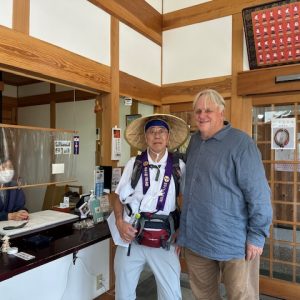
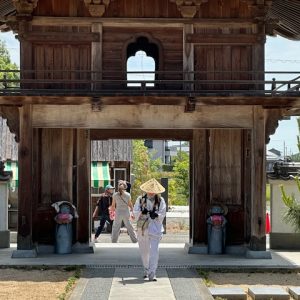
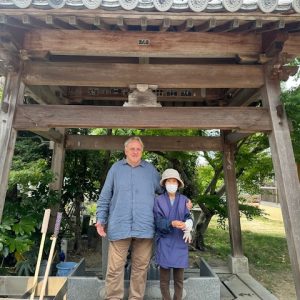
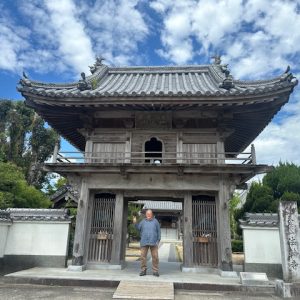
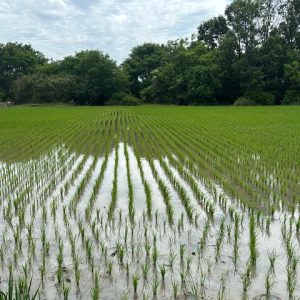
I start my 5th expedition with a very beautiful temple. It is on very flat ground with beautiful nearby rice paddies, in the distant mountains.
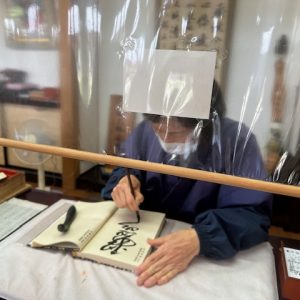
The temple is very well maintained. A little lady of 78 years seems to do everything from stamping to cleaning. She is assisted by a cat.
She has been working at the temple for 18 years. It was only at the temple that she began doing calligraphy
I met a number of other pilgrims, from Nagoya and Chiba.
Once again I forgot my stamp book so I had to buy a new one.
My nickname of Hari Otoko — sunny boy— remains intact as the sunny weather defied the forecasts.
In ancient times, this temple was called Hakubazan Horinji Temple. It is said to have boasted a magnificent temple complex in the mountainous Hochigakei area four kilometers north of the present site. Today only the foundation stones and burned earth remain, as the temple was destroyed by fire during the invasion of Tokushima in 1582 by Motochika Chosokabe, the Lord of Tosa (present-day Kochi Prefecture).
According to legend, in 815 Kobo-Daishi found a white snake while he was making a pilgrimage in this area. The white snake was said to be a messenger of Buddha, so Kobo-Daishi carved a statue of a Reclining Buddha and founded the temple, making the statue the principal object of worship. The Reclining Buddha is lying with its head to the north, face to the west, and right side down. Nearby is a white, withered, sarasutra tree and statues of arhats and animals mourning for Sakyamuni. It is openly displayed every few years.
The temple was moved to its current location and rebuilt during the Shoho era (1644-1648). It is said that the abbot at that time founded Kakaku in Tenborin, and changed the mountain name and the regular name of the temple to Shokakuzan Horinji. However, the temple was again damaged in 1859. This time a fire broke out inside the temple while villagers were rehearsing a joruri play (a puppet play), and the temple was destroyed by fire, leaving only the bell tower. The temple was rebuilt in its present form during the Meiji period (1868-1912).
The temple treasures include Kobo Daishi’s robe. It was given to Horinji by Emperor Meiji in 1882 when Kobo Daishi’s robe at the inner sanctuary of Koyasan was changed.