Origin of Lourdes
France’s most important pilgrimage site
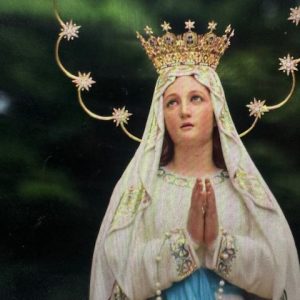
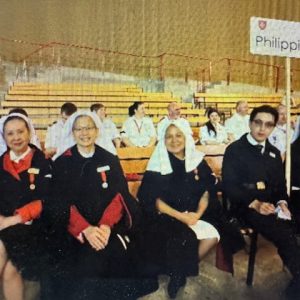

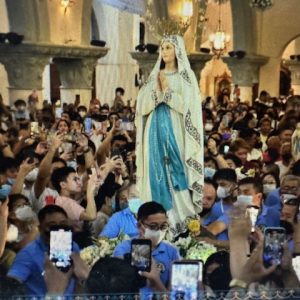


One thing that surprises me most is the devotion of my highly educated Philippine friends to the cult of Bernadette, based in the French town of Lourdes.
Believing that history can provide insights into such things, I turned to Norman Davies’ 1400 page book, Europe: A History.
Here is what Davies had to say:
“Between 11 February and 16 July 1858, in a grotto near the town of Lourdes in Bigorre, a malnourished, asthmatic waif, Marie-Bernarde Soubirous, saw a series of eighteen remarkable apparitions. She heard a rushing wind, then saw a beautiful young girl in a white dress and a blue sash, with golden roses at her feet. The apparition told Bernadette to pray, to be penitent, to build a chapel, and to drink of the fountain.
On one occasion, it announced, in patois, that it was immaculada concepciou, ‘the Immaculate Conception.’ It let itself be sprinkled with holy water as proof against the Devil; and it showed itself capable of punishment and reward. Townspeople who blasphemed about it fell sick. Others who trampled the roses near the grotto found their property damaged. The water from the fountain proved to have healing powers.
At first, neither the civil nor the ecclesiastical authorities were impressed. They interrogated Bernadette at length, creating a large corpus of evidence; and they placed a barrier round the grotto. When they could restrain neither the locals nor the stream of visitors, they removed Bernadette to a convent at Nevers.
In due course, they decided to join what they could not beat, building a huge basilica to receive the pilgrims, and a Catholic medical centre to test the claims of miraculous cures. Lourdes was to become the largest centre of Christian faith-healing in Europe.
In Church History, St Bernadette (1844–79) belongs to the large company of Marian visionaries and Catholic devotionalists who upheld traditional religion against advancing secularism. Together with the consumptive St Thérèse Martin (1873–97), ‘the Little Flower of Lisieux’, whose autobiographical History of a Soul became a sensational best-seller, she helped to demonstrate the sanctity of the suffering believer. As such she was recruited for the French Church’s struggle against its foes. She was canonized in 1933, eight years after St Thérèse.
In another respect, the case of Bernadette Soubirous suggests that the age of social modernization in which she lived was not quite so simple as conventionally portrayed. Historians have described the process whereby peasants were being steadily changed by state schooling and military service into uniform Frenchmen.
But the events of 1858 show other factors at work. Everyone in Lourdes, even the bishop, spoke patois. No one suggested that Bernadette was mad, or a devil-worshipper. She described no ordinary Madonna, and no Christ-child. She belonged to a timeless community, where water was venerated and where the rituals of washing, whether of clothes or of the dead and the newborn, was strictly woman’s work.
She lived in a region, where, though the bishop had been repairing Marian shrines, the caves and grottos of the Pyrenean wilderness were still held to be the haunt of fairies. She even called the apparition petito demoisella—a phrase sometimes used for ‘fairy’. Her barefoot, lice-ridden body, her stubborn consistency, and, above all, the long hours on her knees in positions of ecstasy, proved very convincing. It has been suggested that her body language was acting as ‘a non-verbal vehicle for social memory’. Bernadette was conveying something which her neighbours took to be authentic.