Dōryūji Temple 77, Shikoku
The temple was founded in 712


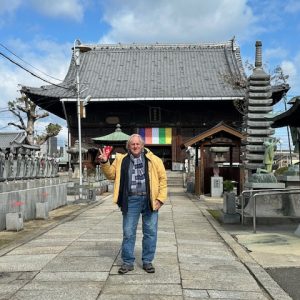
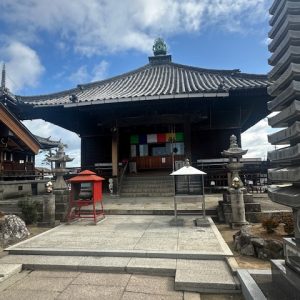


A row of bronze Kannon Bosatsu (Bodhisattva Who Hears the Sounds of the World) statues stands inside the Niomon gate of Dōryūji. At the time of the temple’s founding, this area was a vast mulberry orchard and silk production area. According to legend, the temple was founded in 712 when Wake Doryu, a lord of the area, cut down a large mulberry tree, carved a small statue of Yakushi Nyorai (Medicine Buddha), and built a hut.
Doryu saw a large mulberry tree, nearly five meters in circumference, emitting a mysterious light every night. He was suspicious of this light, so he shot an arrow at the tree. Suddenly he heard a woman scream. Nearby, a nursemaid of the woman who had screamed lay dead. Grieving, Doryu carved a statue of Buddha from a mulberry tree and enshrined it in the hut as a memorial for the dead nursemaid. In 807 Kobo Daishi carved a 90-centimeter statue of Yakushi Nyorai and placed the image of his father, Doryu, within the larger statue to serve as the principal image of the temple.
Kobo Daishi appointed Lord Tomosuke to became the second head priest of the temple. He used his ancestral property to build seven major temple buildings and named the temple Dōryūji after his father. The third head priest was Shinga Sojo (Norimitsu Daishi), Kobo Daishi’s younger brother, who built 23 monk’s cells. The fourth head priest, Enchin (Chisho Daishi), placed the statues of the Godai Myōō (Five Vidyārāja, Five Wisdom Kings) and Sho Kannon Bosatsu (Bodhisattva Who Hears the Sounds of the World) and built the Gomado.
The temple became an Imperial Temple in the time of the fifth head priest, Shobo (Rigen Daishi). The temple prospered as a result of these important priests becoming successively head priest of the temple, but it suffered a series of ups and downs, including the collapse of the pagoda due to a severe earthquake during the Jigen era (976-78), and fires in 1060 and again in the Tensho era (1573-1592). Even so, the temple continues to pass on the teachings of Buddha.