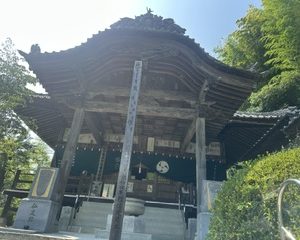
Eifukuji, temple 57, Shikoku
A lovely small temple
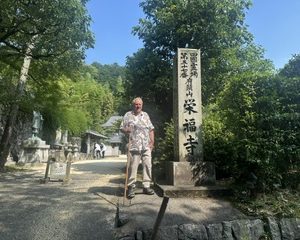
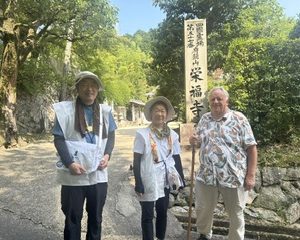
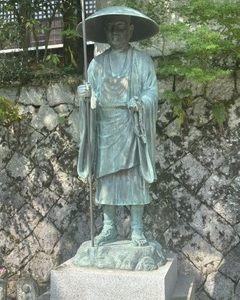
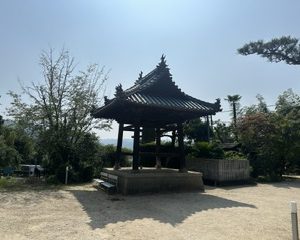
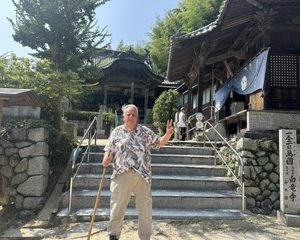
I met an old man from Osaka, a former high school chemistry teacher. Also met a couple from Takamatsu, former engineer and elementary school teacher of disabled students. It’s very unusual to meet people from Shikoku. Most pilgrims are Japanese, but from other islands.
The Seto Inland Sea coastline has been the site of many maritime accidents. Eifukuji has been a place of worship since ancient times, to pray for safety on land and sea and for happiness and longevity, ever since Kobo Daishi conducted a ritual for sea gods.
Let’s look at the legend of the temple. During the Konin era (814-824), Kobo Daishi made a pilgrimage to this area by order of Emperor Saga (reigned 809-823). He prayed for safety from wind and waves on the inland sea, and to avoid accidents at sea, and he performed a Goma fire ritual at the top of Mt. Futozan.
On the final day of the ritual, the winds and waves subsided, and a statue of Amida Nyorai (Buddha of Limitless Light and Life) drifted across the sea. This statue was enshrined as the principal image in a hall built on the summit of Mt. Futozan. The temple became an imperial temple.
Eifukuji also has a history of the syncretism (blending) of Buddhism and Shintoism. In 859, Gyokyo Shonin of Daianji Temple in Yamato received a divine message from the Usa Hachiman shrine in Oita and decided to build a branch shrine of Usa Hachiman, named Otokoyama Hachiman or Iwashimizu Hachiman, in Yamashiro, Kyoto. While sailing the nearby seas for this purpose, he was washed ashore by a storm. He noticed that the shape of Mt. Futouzan was similar to that of Mt. Otokoyama in Yamashiro, and that the principal image of Amida Nyorai was also the principal Buddha of the Hachiman Daibosatsu.
Gyokyo Shonin enshrined Hachiman Myojin in the shrine grounds and built a shrine pavilion, creating Katsuoka Hachimangu Shrine, which combined Shinto and Buddhist teachings. This Hachimangu Shrine is also called “Iwashimizu Hachimangu Shrine in Iyo.” A stone pagoda with the names of temples and shrines engraved on it stands as a guidepost, along with post, “Shikoku 57th Temple”.
Due to the separation of Shintoism and Buddhism decreed by the Meiji government, the temple was moved to its current location halfway up the mountain, and the shrine and temple became independent of one another. The current Daishido is a relocated version of the hall that once stood at the top of the mountain. A handwritten sutra book from the mid-Edo period (1603-1868) in Eifukuji’s collection bears the inscription “Betto Eifukuji,” and a sutra book stamped with woodblocks from the Edo period also bears the name “Betto Eifukuji.” This indicates that the temple had been accepted as the place for pilgrims to receive stamps since ancient times, not only since the Meiji Restoration.