Enmeiji, Temple 54 on the Shikoku pilgrimage
The temple was repeatedly destroyed by fire, but rebuilt every time.


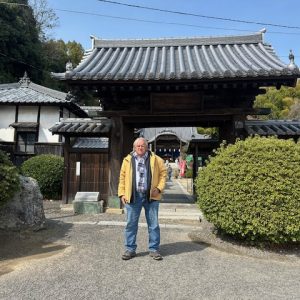
About six kilometers northwest of downtown Imabari, there is a 244-meter-high mountain called Mt. Chikamiyama, which is also the mountain name (temples are metaphorically called mountains) of Enmeiji. Enmeiji is said to have had seven major temple buildings on this mountain with 100 monk’s cells in the valley.
According to legend, in 720, at the order of Emperor Shomu (reigned 724-749), Gyoki carved a statue of Fudo Myōō, which is believed to be an incarnation of Dainichi Nyorai. He founded the temple with this statue as its principal image. In the Konin era (810-824), Kobo Daishi received an imperial order from Emperor Saga (reigned 809-823) to rebuild the temple as a center of religion and learning.
The temple was renamed Fudōin Enmeiji (圓明寺) and designated an imperial temple. The name Enmeiji (圓明寺) continued until the Meiji Restoration (the latter half of the 19th century), but because of confusion with Temple 53, Enmyōji (圓明寺), which is not far away, which had the same Kanji, the name was changed to Enmeiji (延命寺), which had been another name for the temple since the Edo period (1603-1868).
The temple was repeatedly destroyed by fire, but it was rebuilt every time. In 1727 it was moved to its current location at the foot of Mt. Chikamiyama. Before then, in 1268, Gyonen (1240-1321), a monk of the Kegon sect, stayed in the monastery of Enmeiji and wrote Hasshu Koyo, which is said to be an introductory book for beginners in Buddhism. The Hasshu are the eight schools of Buddhism: Kusha, Jojitsu, Ritsu, Hosso, Sanron, Tendai, and Kegon, as well as the newly emerged Jodo. It is written in two volumes.
The temple has the second oldest Shinnen signpost in Shikoku. (Stone pilgrimage signposts created by Yūben Shinnen in the late 17th century.) There is also a Japanese andromeda tree in the precincts of the temple which has pretty white flowers for about a month in spring.