Hantaji, temple 50, Shikoku
Lovely
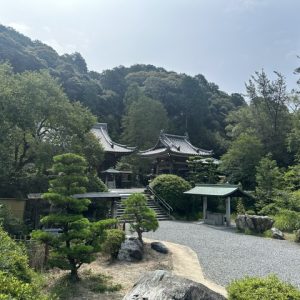
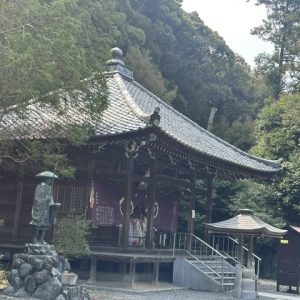

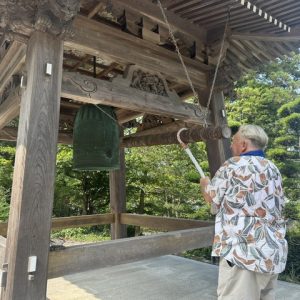
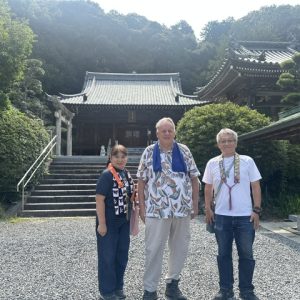
Nice temple snuggly tucked into the forested hillside.
Hantaji is located on a hill with a view of Matsuyama Castle, the city of Matsuyama, and the Seto Inland Sea. Because of its tranquil surroundings, the area around the temple has been designated a Scenic Forest Protection Area.
According to legend, the temple was built in the Tempyo-shoho period (749-757) by order of Emperor Kohken (749-758), and enshrines a statue of Yakushi Nyorai (Medicine Buddha) carved by Gyoki. The name of the temple came from the banner given to the temple as a ritual article by the emperor. During the Konin period (810-824), Kobo Daishi made a pilgrimage to this area and stayed at the temple.
The temple later declined, but was rebuilt with the help of Minamoto no Yoriyoshi, the provincial governor of Iyo (Ehime), and the monk Gyoren. In 1279, at the request of Emperor Go-Uda (reigned 1274-1287), Mongetsu Shonin prayed for the repulsion of the Mongolian army, which was preparing for a second attempted invasion of Japan. Ippen Shonin (1239-1289), the founder of the Jishu sect of Zen Buddhism, also stayed and practiced at the temple when he returned to Iyo from Dazaifu, Fukuoka in his youth. In his later years, in 1288, Ippen dedicated to the temple the Jodo Sanbu Kyō (Three Important Sutras of the Jodo Sect), which had been in the possession of his late father, Nyobutsu.
The temple also has a strong connection with Sennyuji in Kyoto, which is the family temple of the emperor. In 1395, by order of Emperor Go-Komatsu (reigned 1382-1412), the 26th head priest of Sennyuji, Kaio, became the 7th head priest of Hantaji. Because of this connection, the temple still retains tiles bearing Sennyuji’s 16-petal chrysanthemum emblem.
The temple was a major temple with 36 monk’s cells and more than 100 subsidiary temples.