Tatsueji, Temple 19, Shikoku
Making new friends from Hokkaido


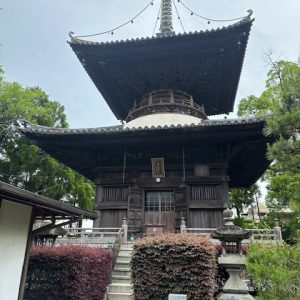

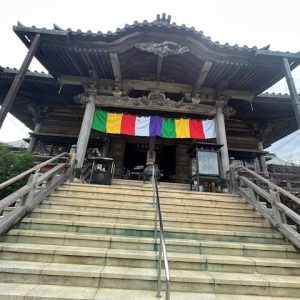

This was a very nice temple, though without the dramatic setting of some other temples. It does have a nice pagoda.
I met a lovely couple from Hokkaido. The gentleman is currently on leave from work so that he could do the Shikoku pilgrimage to commemorate the passing of his father.
There are a variety of reasons that motivate Japanese people to do the Shikoku pilgrimage. They may do so to pray for a deceased person, or when they are changing jobs, or if they feel lost in life, or if they are experiencing unhappiness.
Tatsueji is a bekkaku head temple of the Koyasan Shingon sect. It is considered the fundamental place of the 88 temples of the Shikoku Pilgrimage, and is known as the Sosekisho of Shikoku, the principal barrier station of Shikoku, and Awa no Sekisho, the barrier station of Awa (Tokushima).
According to legend, the temple was founded by Gyoki by order of Emperor Shomu (reigned 724-749). Gyoki carved a small golden statue of Jizo Bosatsu (Earth Treasury Bodhisattva), about 5.5 cm tall, to pray for safe delivery for Empress Komyo. Kobo Daishi saw this statue in 815.
He felt that because of its small size, it might be lost in the future, so he carved a 1.9-meter-tall statue of Enmei Jizo Bosatsu (Earth Treasury of Long Life Bodhisattva) and placed the original image inside the larger one. He also changed the temple name to Tatsueji. At that time, the temple was located in a beautiful area about 400 meters west of the present site, near the mountains. It was said to be a huge temple with seven major buildings.
Tatsueji could not escape the fires of the Tensho era (1575-1785) and suffered a devastating blow. Only the principal image was saved. The temple was rebuilt at its present location with the aid of Hachisuka Iemasa, the first lord of the Awa. In 1974 there was another fire and again principal image was saved.
The Hondo, which was rebuilt in 1977, has a large ceiling painting. It is highly regarded as a cultural asset representing Japanese-style painting of the Showa era (1926-1989), along with the ceiling paintings in the Kannondo. The temple’s legendary Shaka Sansonzu (Three Images of the Historical Buddha) is designated a National Important Cultural Property.
Although the temple was a barrier station which judges evil minds, it was also known by the affectionate name Koyasu no Jizoson and Tatsueji no Jizosan.